

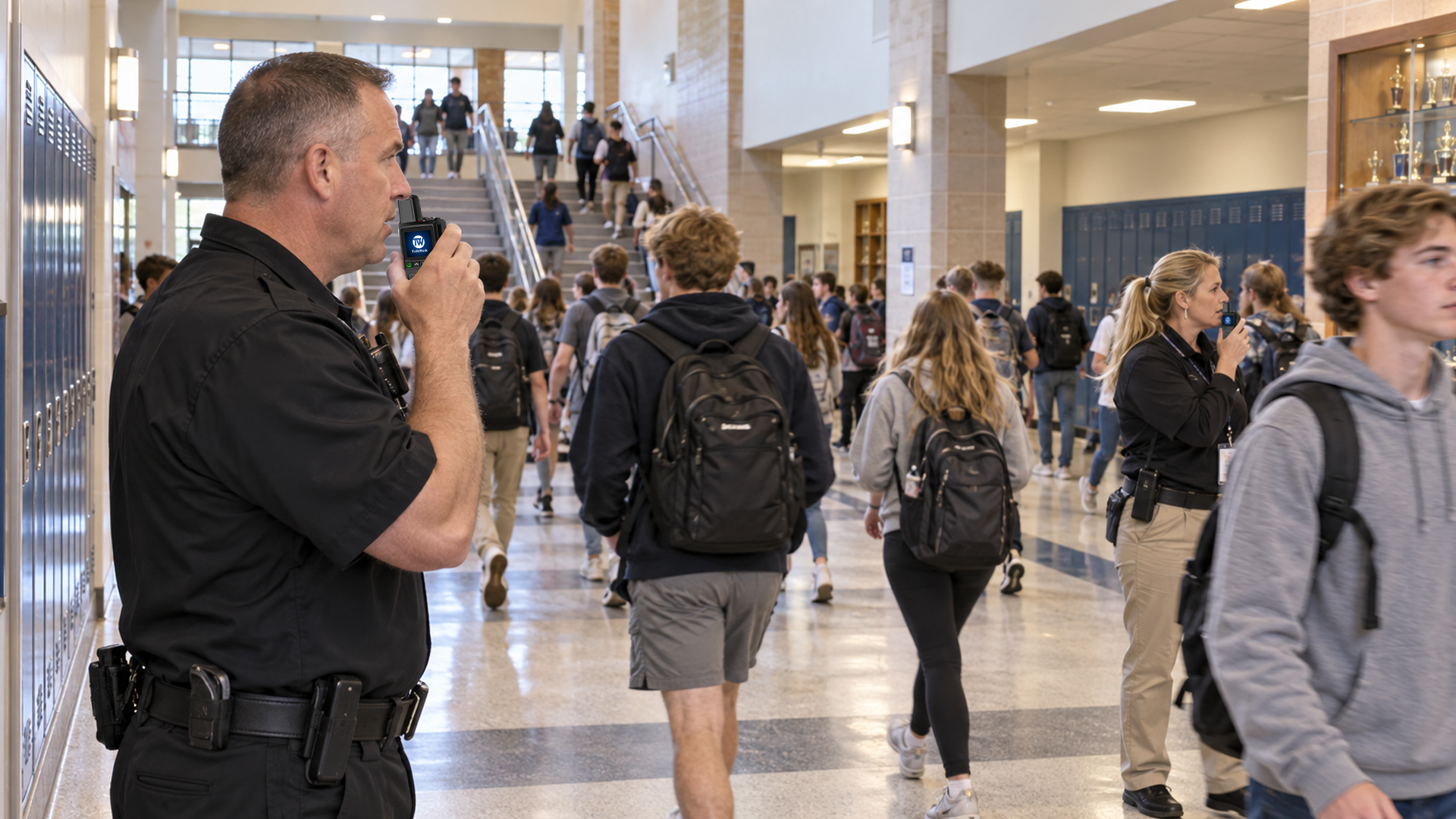
What is a PoC Radio and How Does It Differ on School Campuses?
Traditional analog two-way radios often struggle with structural obstacles, suffering from signal degradation in basements, gymnasiums, and distant athletic fields. Push-to-Talk over Cellular (PoC) bridges this gap by transmitting voice data over high-speed cellular networks (4G/LTE).
| Communication Feature | Traditional DMR / Analog Radios | PoC Radios (e.g., TolkWolk G16) |
| Coverage Area | Limited line-of-sight range (1–3 miles) | Unlimited nationwide / district-wide range |
| Infrastructure Needs | Requires expensive repeaters and antennas | Plug-and-play using cellular networks |
| Obstacle Penetration | Frequent dead zones in basements & elevators | Seamless indoors, outdoors, and across campuses |
| Specialized Capabilities | Basic voice transmission | Voice + Instant Multi-Group Dispatch |
Key Use Cases of PoC Radios in Educational Institutions
1. Campus Security & Emergency Response
During critical events—such as lockdowns, severe weather, or medical emergencies—instant communication is crucial.
-
Instant Group Calling: Administrators and security personnel can push a single button to alert all staff members simultaneously.
-
No-Look Operation: Unlike smartphones, which require unlocking and dialing, PoC radios feature dedicated physical PTT buttons for immediate connection.
2. School Transportation & Bus Fleet Management
School districts must coordinate morning pickups, afternoon drop-offs, and field trips over long distances.
-
District-Wide Range: Bus drivers remain connected with central dispatch across entire cities or counties without losing signal.
-
Seamless Fleet Dispatch: Dispatchers can broadcast route updates and emergency notices to all drivers at once.
3. Daily Operations & Event Coordination
Managing daily arrivals, dismissals, sports events, and facilities maintenance requires reliable cross-departmental coordination.
-
Multi-Channel Workgroups: Facilities, administration, and transportation can operate on separate channels while remaining accessible for cross-channel broadcasts.
Product Focus: TolkWolk G16 Walkie Talkie for School Infrastructure
The TolkWolk G16 Walkie Talkie is specifically engineered to meet the operational demands of educational institutions and commercial campus management.
Key Features of the TolkWolk G16
-
4G LTE Nationwide Network Integration: Eliminates geographical range limits, enabling clear communication between classrooms, district administration buildings, and transit buses.
-
High-Capacity Battery Life: Built to endure long school shifts and multi-day school trips without requiring frequent recharges.
-
Heavy-Duty Construction: Features a rugged chassis capable of withstanding accidental drops on concrete or outdoor playground use.
-
Clear Audio Processing: Advanced noise reduction ensures intelligible voice transmission in noisy environments like sports arenas, crowded hallways, and school buses.
Frequently Asked Questions (FAQ)
Q1: Why are PoC radios preferred over traditional smartphones for school staff?
Smartphones introduce delays due to screen unlocking, dialing, and app loading, and they can be a distraction during class. PoC radios provide dedicated, instant one-touch communication with single or broadcast group channels, ensuring immediate action during emergencies.
Q2: Does the TolkWolk G16 require expensive radio frequency licenses?
No. Unlike traditional High-Frequency or Ultra-High-Frequency (VHF/UHF) commercial radios that often require FCC or local frequency licensing and dedicated repeaters, PoC radios operate over existing cellular networks, significantly reducing setup complexity and deployment costs.
Q3: How do PoC radios maintain reliable coverage across large campuses?
PoC radios leverage nationwide 4G LTE cellular infrastructure, bypassing the power limitations and antenna line-of-sight constraints of traditional two-way radios to ensure crystal-clear voice communication anywhere cellular coverage exists.