

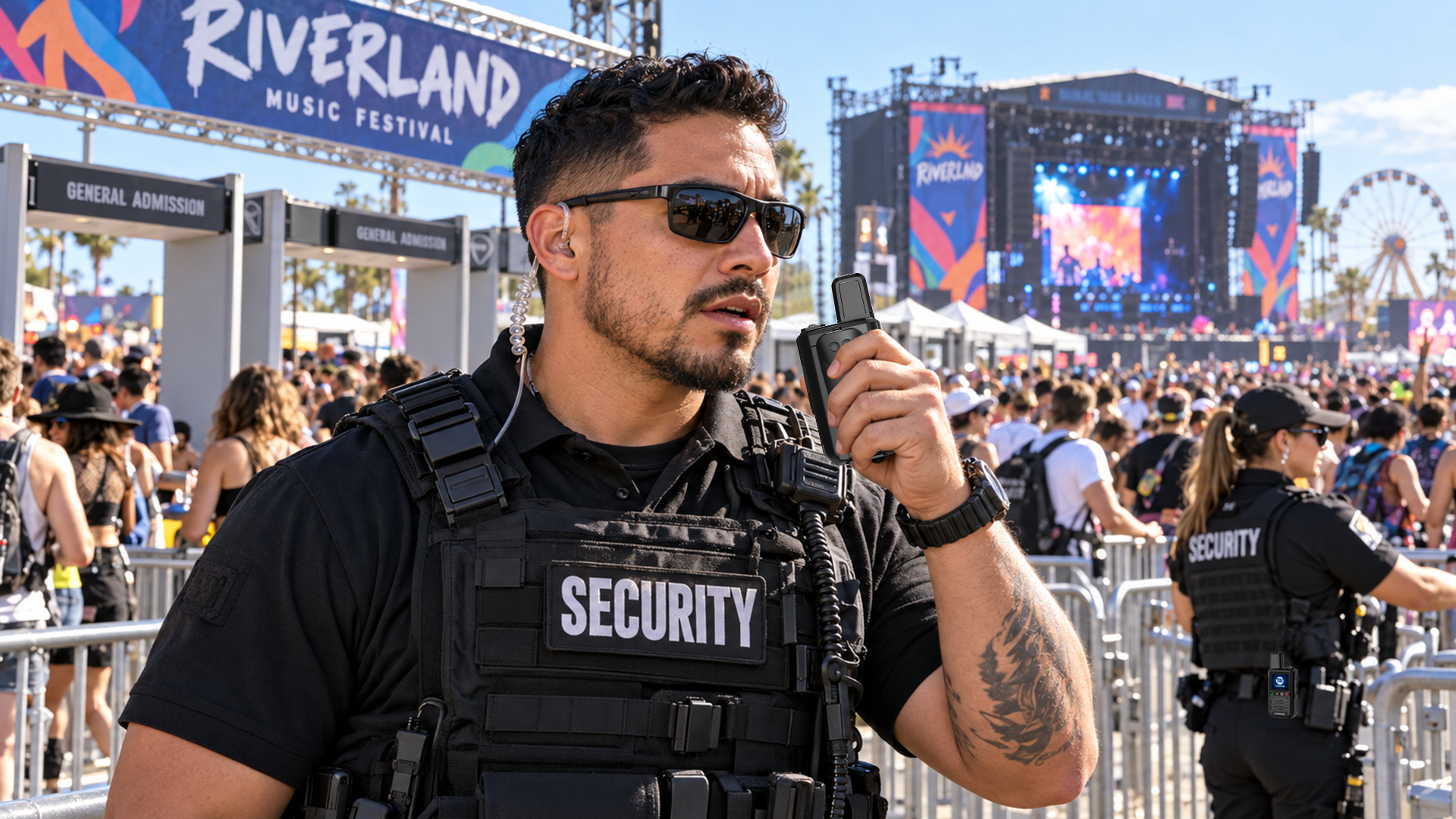
1. Traditional Radios vs. 4G LTE PoC Radios for Festival Security
Maintaining reliable security communication across sprawling, high-noise festival grounds is vital for crowd safety. The table below compares conventional two-way radios with 4G LTE PoC radios like the TolkWolk G16:
2. Key Event Security Challenges Solved by TolkWolk G16
Ensuring Clear Voice Communication in High-Decibel Environments
At festival stages with massive sound systems, traditional analog radios generate unbearable static or muffled voice audio. The TolkWolk G16 features high-output speakers and digital voice processing, allowing security officers and stage managers to receive clear voice transmissions even near main speaker arrays.
Bypassing Network Congestion & Stage Structure Dead Zones
Massive crowds often overwhelm standard consumer cell phone networks, while steel stage scaffolding blocks traditional short-range radio signals. The TolkWolk G16 utilizes multi-carrier LTE SIM connectivity alongside dedicated event Wi-Fi networks to maintain uninterrupted Push-to-Talk (PTT) priority voice channels.
Real-Time Staff Positioning & Rapid Incident Dispatch
When medical emergencies or perimeter breaches occur in crowded festival zones, pinpointing security personnel is critical. Integrated real-time GPS tracking enables the central security command to monitor team positions on a live map and dispatch the nearest officers instantly using one-touch PTT calls.
3. Essential Security Use Cases at Concerts & Festivals
-
Perimeter Patrol & Gate Security: Keep security teams connected across entrance turnstiles, ticket booths, and boundary fences with instant group broadcasts.
-
Stage & Backstage Access Control: Coordinate artist escorts, pit security behind front-of-stage barricades, and VIP area entry in real time.
-
Medical & Emergency First Response: Track field medics via GPS coordinates and broadcast immediate assistance requests without channel interference.
-
Crowd Control & Overflow Management: Synchronize crowd movement updates, parking stewards, and shuttle operations across distant parking lots and camping areas.
4. Frequently Asked Questions (FAQ)
Q1: Why choose TolkWolk G16 over smartphones for event security staff?
Smartphones require unlocking screens, finding contact names, and waiting for calls to connect—unusable in fast-paced, high-risk festival environments. The TolkWolk G16 provides a dedicated physical Push-to-Talk (PTT) button that broadcasts instant voice messages to entire security teams in less than a second.
Q2: Does operating the TolkWolk G16 require an FCC spectrum license?
No. Unlike high-power commercial UHF/VHF radios or repeater-based systems, PoC radios operate over cellular data and Wi-Fi networks, eliminating the need for expensive FCC spectrum licenses and frequency coordination fees.
Q3: Can different security details (e.g., Backstage, Gate Entry, Medical) have separate channels?
Yes. The TolkWolk G16 supports flexible multi-group channel assignments. Different security teams can operate on separate isolated channels while maintaining an overarching "All-Call" channel for site-wide emergency broadcasts.